
- How crown, bow, and cup affect a finished wall
- Why straight framing starts with reading every stick of lumber
- How to orient studs, joists, rafters, and deck boards correctly
- Why good carpenters work with wood instead of fighting it later
One of the first great lessons a carpenter learns is that lumber does not arrive ready to behave. Wood moves. Wood twists. Wood remembers the tree it came from. The trick is not finding perfect boards. The trick is knowing how to read imperfect ones and make them work together.
I grew up in the building industry. When I started with my grandfather’s company, we did not hand every task off to a parade of subcontractors. Other than licensed trades—electricians, plumbers, and HVAC men—we built the project from the foundation to the shingles. That kind of work teaches you things that never seem to make it into modern DIY television. This is one of those lessons.
Some of these tips were once guarded. Others were simply common knowledge among seasoned craftsmen. Today, many younger artisans have never been taught them at all.
A straight wall is rarely built from perfectly straight boards. It is built by a carpenter who understands how flawed boards behave.
“God makes lumber. We make it straight.”
Several years ago, I met with a wealthy businessman who liked to think of himself as a part-time builder. He invited me to a project site where an ICF crew was assembling the exterior walls. He was enthusiastic about any building method that sounded efficient, sustainable, or simply unusual enough to be interesting.
After we talked through the schedule, he asked whether I framed with steel studs. I told him I had, many times. He brightened and asked whether he should use light-gauge metal or structural studs throughout the interior because, as he put it, he did not like lumber. Lumber, he said, was not straight.
I answered him the same way I have answered many people since: “God makes lumber. We make it straight.”
That is not just a line. It is the job. If you are framing walls, decks, ceilings, or roofs, you are not merely assembling components. You are selecting and orienting material so that its natural imperfections cancel one another out instead of compounding into a crooked finished product.
Lumber has three flaws you must read every time
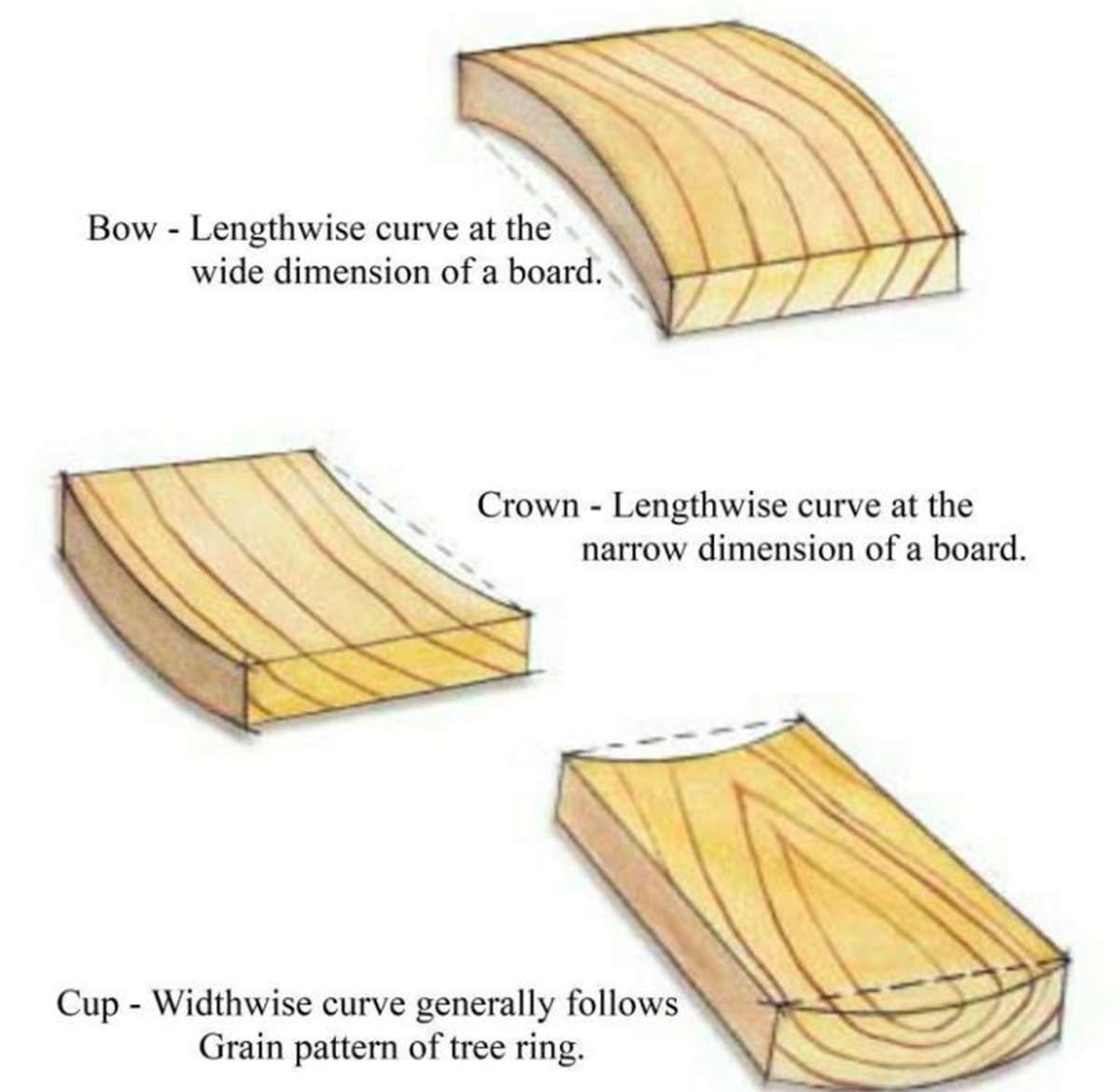
For practical framing purposes, there are three flaws you must learn to recognize every time you pick up a board: crown, bow, and cup.
Crown is the slight curve you see when looking down the edge of the board lengthwise. Bow is the long sweep a board takes along its face. Cup is the hollow or dish shape across the width of the board. Ignore these, and your wall will tell on you later.
You may not notice it when the framing is fresh, but once sheetrock, trim, cabinets, or decking go on, those defects announce themselves in ugly ways. A finished wall may wave in and out. A deck plank may hold water. A framed opening may look slightly wrong without anyone knowing why. The reason is often hidden back at the point where the carpenter failed to read the board before installing it.
Crown your wall studs the same direction
When framing a wall, lay out your top and bottom plates first. As you install the studs, place them so that all crowns run in the same direction. There will always be slight variation from stud to stud, but uniformity is the goal. If half the studs crown one way and half the other, the face of the wall will look like it is thinking two different thoughts at once.
When all crowns are oriented together, you greatly reduce the wavy look that shows up later in the sheetrock. No, the wall still will not be mathematically perfect. But it will behave as one plane instead of many competing ones.
If you want the wall to stay straighter over time, add mid-blocking. Code may require fire blocking once walls reach certain heights, but I like mid-blocking even when the code does not force the issue. Lumber continues to dry and move as it ages. Blocking helps keep that movement under better control.
If you do not sight every board, read the crown, and install with consistency, no amount of confidence will make the wall look better later.
Crown structural members up
When building decks, pier-and-beam floors, ceiling joists, or rafters, always install the crown up. Gravity is going to pull on that member for the life of the structure. A crowned board set upward gives you a little room for that load to settle. A crowned board set downward starts the sag before the structure even goes into service.
This is one of those habits experienced carpenters develop almost without thinking. They know the member will eventually relax under weight. By starting with the crown up, they let the load work with them instead of against them.
Deck boards and cup matter too
When installing deck planks, place the concave face down whenever possible. That is the side that would otherwise tend to catch water and form a shallow cup on the walking surface. Turning the cup down helps the board shed water better and usually gives you a more durable result.
If you are using lesser grades of lumber, you may also notice that one face looks better than the other. That is not your imagination. The closer the grain is to the heart of the tree, the better the material often appears. If appearance matters, buy the best grade your budget will tolerate and expect to cull a few pieces. Cheap lumber often costs more in frustration than it saves in dollars.
Do not forget the plates
The plates matter too. Crown them consistently just as you do the studs. If the top and bottom plates are both crowned with intention, the process of plumbing, lining, and blocking the wall becomes much easier. Most framing errors do not come from one dramatic mistake. They come from a series of small careless choices that accumulate.
That is why good framing looks so effortless when done by someone experienced. He is not fighting the lumber at the end because he read it correctly at the beginning.
What many DIYers miss
Most DIY instruction focuses on spacing, fasteners, and tools. Those things matter, of course. But the difference between a rough wall and a professional-looking one usually shows up in material selection and orientation. Straight framing is not just about measuring correctly. It is about thinking like a carpenter.
That means understanding what the wood is trying to do before it does it.
The bottom line
Lumber is a natural material, and natural materials come with personality. The pro does not complain that lumber is imperfect. He expects it. Then he uses judgment, blocking, layout, and orientation to make the finished work look true.
If you are framing your own wall, remember the rule: read every stick, crown with purpose, cup with intention, and never assume a board belongs where it landed in the pile. That is how you frame straighter, faster, and with a better finished result.
Straight framing is not about luck. It is about seeing what the board wants to do before you decide where it belongs.